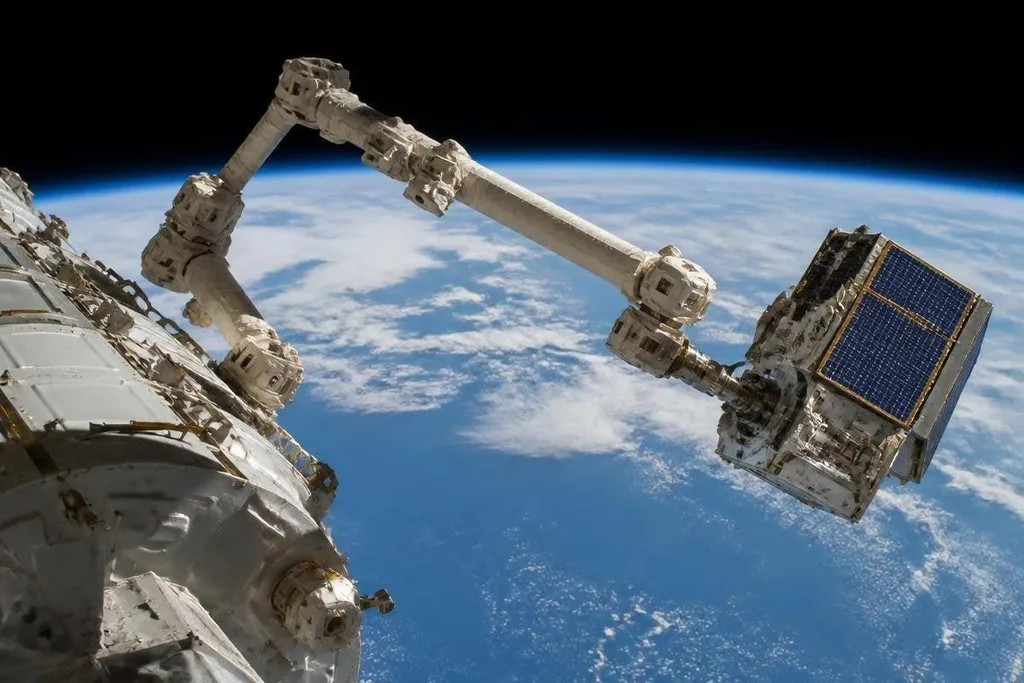
A space robotic arm can move a satellite, hold a tool, or pass cargo without a person gripping it by hand. Its joints, motors, cameras, and control software work together because microgravity changes how every movement affects the spacecraft.
- A joint creates motion through a motor and gearbox.
- Cameras and force sensors help the arm find and hold its target.
- Slow movements protect the spacecraft, the load, and nearby people.
The arm starts with joints and motors
A robotic arm is built from linked sections. Each joint turns around one axis, much like a shoulder, elbow, or wrist, though space arms use motors and gearboxes instead of muscles.
Many arms use six degrees of freedom. That means the arm can move in three directions and rotate around three axes. More joints can give the arm extra reach and let it work around equipment.
The controller sends a position to each joint. Encoders report the joint angle back to the controller, so the system can check whether the arm moved as planned. If one joint turns too far, the control system can stop the motion before the arm reaches a nearby structure.
Space brings a problem that a factory floor can hide: the arm and the spacecraft push on each other. When the arm moves a heavy load, the spacecraft can rotate in the opposite direction.
The controller must account for that motion, or the arm may miss its target.
Why microgravity changes the job
On Earth, gravity pulls a load down and gives the arm a fixed reference. In orbit, the spacecraft and its load are in free fall together. The load still has mass, so it resists changes in speed, but it doesn't sit on a table and stay put.
That makes speed and acceleration important. A fast arm can set the spacecraft moving, shake a delicate part, or make a captured object swing. Space arms therefore use planned paths with controlled starts and stops.
The spacecraft may also need to lock itself in place. A base-mounted arm can use a stiff attachment point, while a free-flying robot needs thrusters, reaction wheels, or another way to control its body. Safe work depends on a steady base because the arm can't do its work safely if the base keeps drifting.
Sensors tell the arm what it is touching
Position sensors tell the controller where the joints are. Cameras can help the arm locate a handrail, cargo fixture, or tool. Force and torque sensors measure loads at the wrist or gripper, showing when the arm has made contact.
That contact signal matters during a handoff. A gripper may need to close around a handle without crushing it, then hold the load while another mechanism takes over. It can slow down when resistance rises instead of continuing to push.
Light behaves differently in orbit, too. Sunlight can create hard shadows, while dark surfaces can disappear against space. A control system may combine camera images with known fixture positions and joint angles rather than rely on one picture.
Those limits make the arm’s motors and joint feedback worth comparing with robots on Earth. Robot24.com space robotics reporting can place the orbital hardware beside industrial and autonomous systems before the next section looks at the tool that gives the arm its job.
The tool at the end decides the task
The arm's final part is called an end effector. It may hold a handle, turn a tool, carry a package, or connect to a fixture. That main arm can stay the same while a different end effector changes the work it can do.
The connection must survive vacuum, temperature changes, radiation, and repeated loading. Lubricants, seals, cables, and electronics need protection because repair is difficult when the arm is outside a spacecraft.
A space arm also needs safe failure behavior. If power drops, the joints need a way to stop or hold position. If a sensor gives a bad reading, the system needs limits that keep the arm away from the spacecraft and its crew.
A practical check before judging a space arm
Use these points when comparing a design or a mission plan:
- Reach: Check the working area, not the arm's full length on paper.
- Load: Ask how much mass it can move while keeping the required accuracy.
- Base motion: Find out how the spacecraft controls the push from each movement.
- Sensing: Look for cameras, joint encoders, and force or torque feedback.
- End effector: Match the tool or gripper to the fixtures it must handle.
- Fault response: Check how the arm stops, holds, and recovers after a sensor or power fault.
The useful measure is the complete task. A long arm with weak sensing may struggle with a small fixture, while a shorter arm with good force feedback may handle it safely.
Space robotic arms work through the same basic pieces as Earthbound robots: joints, sensors, software, and a tool. Their hard part is controlling motion when the base, load, and arm can all move at once. The next design question is how much work can be done without sending a person outside the spacecraft.